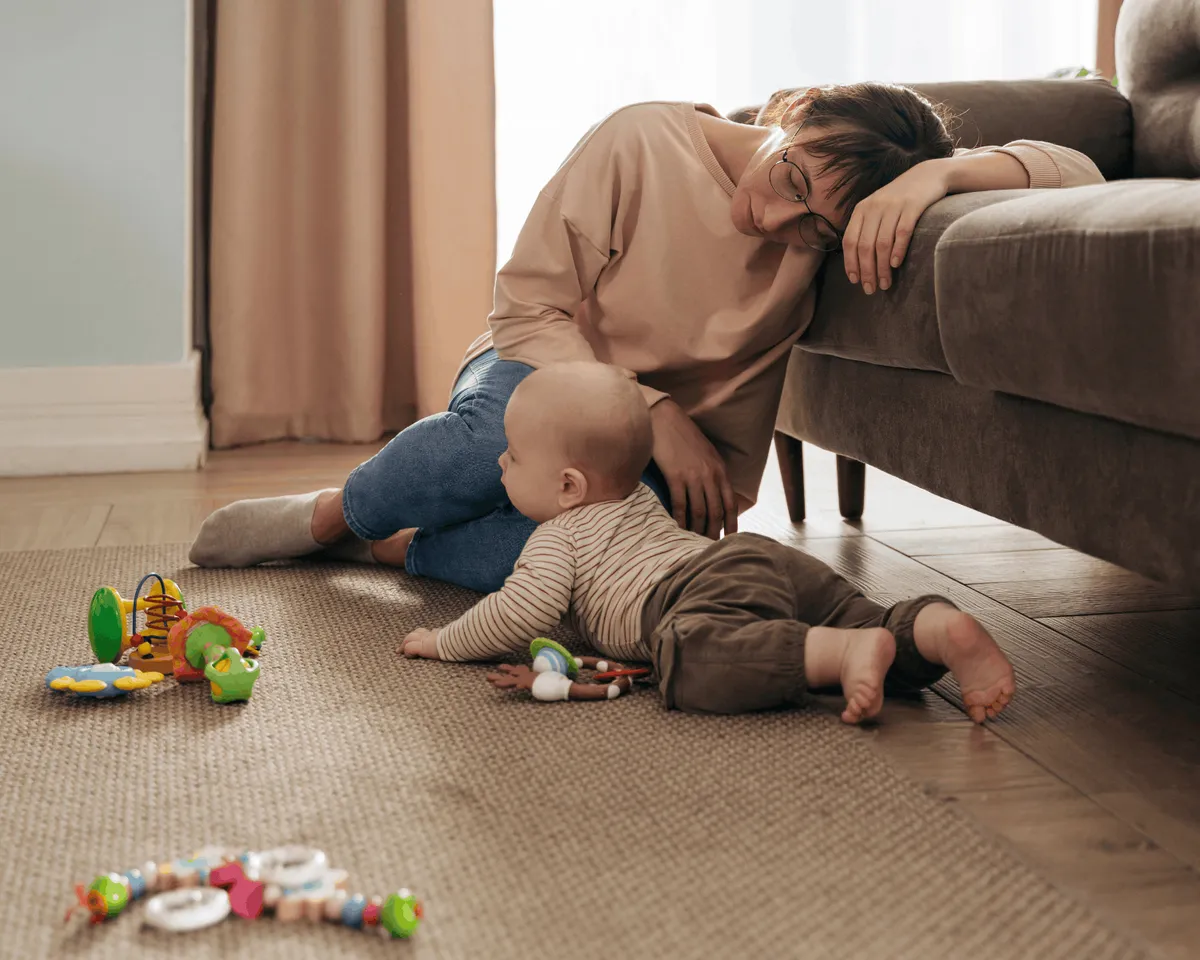
Parent Burnout: Parenting When Your Nervous System Has Nothing Left
This has nothing to do with your patience, and everything to do with capacity.
If you've searched ‘how to stay calm as a parent’ after another day that ended in yelling, guilt, and replaying it all at bedtime... you're not alone. Due to the pressures on parents in our world today, many have nervous systems running on empty, and no amount of breathing through it will refill that tank.
As a Neuroaffirming Somatic Clinical Counsellor, Craniosacral Therapist, and mom of a ND family, I've spent years supporting parents who love their children deeply and still feel like they're one spilled cup away from losing it. What’s missing is capacity, and a different understanding of what it means to be a safe adult for your child.
What You'll Learn About How to Stay Calm as a Parent
Why parent burnout and mom rage are signs of a nervous system with nothing left, not a lack of patience
What parenting when overwhelmed is doing to you and your family nervous system, and how to create sustainable change
What it really means to be a safe anchor for your child, and why gentle parenting scripts aren't enough
How to interrupt the patterns that were passed to you, without having to heal everything first
Scroll down if you prefer to explore with me on YouTube!
Parenting When Overwhelmed: The Moment You Hear Your Own Voice
It's 5:30 pm. Dinner is half made, someone desperately needs a snack, someone else is crying about a sock, and you know you’re about to blow if there’s another noise or demand.
And then you hear it: your own voice, sharp and loud. Maybe the exact tone you swore you'd never use. After bedtime, you replay it: the look on your child's face, the apology you gave, and the quiet promise to do better tomorrow.
If this is you, you're not alone. It's not because you don't know better. You know exactly what you want to do in those moments, but you can’t.
Parent Burnout Isn't a Character Flaw
Parent burnout happens when the demands on your nervous system outpace its capacity for long enough that there's no margin left. Broken sleep, constant noise and touch, a sensitive or ND child who needs more of you, and very little support for you. Many of us are also carrying our own sensory sensitivities and unmet needs (like those couple of hours you were supposed to get two weeks ago)... and were never taught how to notice them.
You might recognize these signs if you’ve experienced parent burnout:

You’re drained before the day begins
Your ability to multitask or handle multiple sensory inputs is non-existent
You have far less patience than you used to & you go from 0 to 100 in an instant
You notice yourself pulling away emotionally from your children, or feeling flat
It’s hard to make sense of what you need, or need to do next
When there's no capacity, the body shifts into an activated state, and when you’ve been there for too long… you move into burnout. It's also far more common than most parents realize. When The Ohio State University surveyed nearly 1,300 working parents, 66% met the criteria for burnout, and mothers carried the heaviest load (Gawlik & Melnyk, 2022). Burnout is also linked to depression, anxiety, drinking more, and to parents becoming more irritable and quicker to anger with their children.
For parents of sensitive and ND children, the load is heavier still. A meta-analysis comparing parents of autistic children with parents of typically developing children found a large gap in parenting stress (Hayes & Watson, 2013). Add the appointments, the constant advocacy, the broken sleep, being on-edge every day, missing work, and stress around the financial impact and the fact that many of are also wired sensitively, and the load is far heavier (Autismspeaks.org, ND; Marsden et al, 2025).
How to Stay Calm as a Parent: Listen to the Mom Rage Before It Becomes Too Much
If one minute you're fine, and the next your scream is out before you can catch it, you’re not alone. When UBC researchers surveyed 278 Canadian mothers in the first year after birth, 31% reported intense anger, more than the 26% who showed signs of probable depression. More than half of the mothers with intense anger didn't screen for depression at all, and one of the clearest links to that anger was sleep (Ou et al., 2022).
In other words, mom rage isn't just depression in disguise, but its own experience that rarely gets addressed. Mom rage tends to show up when your own needs have been ignored for too long - lack of sleep, personal time, even a moment to catch your own breath without a demand.
Many of us were also raised to be the "good girl," and learned early that anger was not acceptable in girls or women. So our anger got buried and we never learned tools to move through it. Your rage is simply your body saying “something has to change.” The work is to hear it, before it has to shout.
And underneath the rage, for many parents, is a quieter fear: I don't want my child to grow up feeling what I felt.
What Gentle Parenting & Other Parenting Philosophies Missed
Gentle parenting gave many of us language we never received: validating feelings, holding boundaries without shame, staying close through the hard parts. Gentle parenting seems to have peaked when parents had the increasingly high demands, and the least capacity. For it's slid into permissive parenting, where boundaries slide and many parents find themselves in cycles of caving to avoid a meltdown, because who has the capacity for another meltdown?!
Gentle parenting asks you to be the steady presence in your child's storm, and rarely asks who's steadying you. This doesn’t work. When the scripts come from a body running on fumes, the child feels the incongruence between words and energy, resulting in anxiety, overwhelm, and meltdowns. When a parent doesn’t have the capacity to be consistent, the child struggles to understand the expectations and boundaries.
Imagine you had a boss who was fine with you going for a long lunch one day, then raged at you the next day. You’d be walking on eggshells, gauging the mood they were in constantly. Your anxiety from this relationship would ripple into how you felt about yourself around them, your other interactions, and the energy you carry home with you.
A lack of capacity can inadvertently create the opposite effect of gentle parenting’s goal, which can lead to anxious children. Often these anxious children appear ok, but inside there’s a lack of safety and stability. And when this happens, there’s often an inability to notice their own feelings and process these in a healthy manner, which further amplifies overwhelm for them and the family system - because we are all co-regulating, all the time.
Parenting When Overwhelmed & What It Means to Be a Safe Anchor
We tend to picture a safe parent as an endlessly calm one, but an anchor holds the boat steady even when the waves are choppy. Sometimes it is overwhelming, and sometimes we aren't as calm as we hoped to be for our children.
The real issue is capacity, which I appreciate is tricky in our demanding world. A child who grows up beside a parent who's always bracing learns to brace too. They become expert room-readers, tracking faces and moods and adjusting themselves before anyone asks... and this is when they become so externally oriented that they forget to hear themselves.
When we’re able to build greater capacity in our system, we’re able to be our child’s anchor. They feel the congruence of our words, actions, and energy. They know they are safe in our presence and that they can expect consistency. They know you’re able to hold space for them, allowing them to move through their emotions and experience, and that you’ll still be there after.
This might mean you need a minute in the hallway, but you come back every time and talk to them: "I got overwhelmed and needed to centre myself, so I could be present with you." We’re all doing the best given our circumstances and the knowledge we have, but capacity must come first - this is the foundation to raising safe, confident children… and to thriving yourself.
The Pattern Stops Here: Interrupting What Got Passed to You
If your parents raged, went silent, or needed you to be the easy one, your body learned to survive that. These are the same subconscious patterns that live on in your nervous system, and are triggered during moments of stress. That's how patterns travel: not through what we believe about parenting, but through how we respond during challenging moments.
You don't have to be fully healed to raise a child who feels safe. Developmental psychologist Dr. Ed Tronick spent decades filming parents and babies frame by frame. He found that even in healthy, loving relationships, parent and baby are truly in sync only about 20–30% of the time (Tronick & Gold, 2020). The rest is misses: missed cues, mismatched moods, small ruptures. Security isn't built by avoiding those misses. It's built in the repair that follows.
So the pattern doesn't stop the day you never yell again. It stops the first time you come back and say what your own parents couldn't: "That wasn't okay, and it wasn't your fault. I’m sorry."
Your children will inherit your ability to be human, unafraid to notice their emotions, and able to repair. With capacity and practice, we build the muscle to notice what we’re feeling before it becomes too much - the very same skill we’re trying to help our children develop. An emotion is simply energy in motion - a signal. And when we can recognize these signals earlier, we’re better able to be compassionate with ourselves and ask for what we need, before it spills over.
How to Stay Calm as a Parent When You Have Nothing Left: Questions Parents Ask
"Other moms seem to handle this. Why can't I?" You're comparing your inside to their outside. Many have learned to hide it, and then there are others who have support and capacity. We also each go through different waves on our parenting journey, have different needs, and are dealing with different challenges.
"Isn't gentle parenting supposed to fix this?" The values behind gentle parenting are beautiful, but gentleness has to start with your own nervous system. Without capacity, even the kindest script becomes one more performance.
"What if my partner doesn't get it?" Start with yourself. One steady adult in the home changes more than you'd think, and your shift often opens the door for others. Family therapy is also a very positive form of support - it’s just a matter of finding the right fit for your family.
You Can't Do This Alone (No One Can)
For most of human history, nobody raised children alone. There were grandmothers, aunties, older siblings, and neighbours: other adults whose arms and nervous systems shared the load. Today, many parents are doing a village's worth of work with one or two adults (sometimes one).
In a study of more than 17,000 parents across 42 countries, researchers found parental burnout was highest in individualistic Western cultures, often focused on performance and perfectionism (Roskam et al., 2021). Individualism predicted burnout more strongly than economic inequality, the number or age of children, or even the hours parents spent with them. No bubble bath fills that gap. Capacity is built inside you and around you.
If you’re still wondering how to stay calm as a parent… here's some tips:
Make the invisible load visible. List everything you hold in a week, including the remembering, planning, and emotional tracking. Most parents are shocked by how long it is.
Ask for help with one specific thing. "Can you take Tuesday pickup?" lands far better than "I need more help."
Protect your hardest hour. Put support before it, not after. You know when meltdowns are more likely to happen: what are the triggers, and what tends to help?
Get professional support. We all need people we can lean on, ask for help with our blind-spots, and someone to see the forest for the trees.
Tomorrow, when the heat starts to rise, say it out loud: "I'm getting overwhelmed." Naming it gives your body a beat of space, and shows your child that big feelings can be spoken.
Go here if you’re ready to begin building capacity in your system.
🌺 Katherine
CCC. RCC. ERYT-500. RCYT. YACEP
Please note that this information is intended for educational purposes only and should not be considered medical advice. Always consult with a healthcare professional for personalized guidance.
Resources:
Canada/ US Emergencies: 911
Canada/ US Suicide Crisis: 9.8.8
Suicide Prevention: 1.800.784.2433
Women’s Crisis & Support: 1.877.890.5711
US Maternal Mental Health: 1-833-TLC-MAMA (852-6262)
Send Me a Message for Further Support (I respond within 72h):